
HIGH-SPEED rail services between Spain's largest two cities and France have been snapped up by half a million passengers in less than nine months, reveals the transport board.
Sign in/Register
Looking for the Professionals/Advertiser Login?
By Signing up you are agreeing with our Terms and Privacy Policy.Forgot your password?
Feedback is welcome

Über and Cabify, which offer self-drive and chauffeur-driven cars, and BlaBlaCar, where people travelling in their own vehicles sell off seats to others going in the same direction, have been a major bug-bear of licensed cabbies in major cities in particular, especially those with heavily-used airports.
Several Cabify cars were torched during the famous Feria de Abril in Sevilla, and although taxi drivers typically condemn these actions, at least two in the southern city are under police scrutiny.
A slow march will start at noon on Tuesday from Madrid's central Atocha station, heading along the Paseo del Prado – near the celebrated art museum of the same name – and expect to reach the Neptune roundabout by around 13.30.
They will then meet with spokespersons for public works, transport and infrastructure from Spain's two main left-wing parties, the PSOE (socialists) and Unidos Podemos.
According to the self-employed cabbies' confederation chairman Jorge Sanz, the taxi-driver community has 'exhausted all possible channels with local, regional and national authorities'.
Among their demands are that, if they cannot stop Über and Cabify from running, their numbers should be capped at one vehicle per 30 taxis.
The current figure is around one per 12 and growing fast.
Taxi drivers also want to see a ban on alternative transport methods such as these on working in other areas besides those where they are designated, and for IVA on their fees to be at the full 21% rather than the middle-band rate of 10%.
Sanz hotly denies accusations that the taxi trade wants to continue its road-transport monopoly and is 'hostile to change' in society, saying they just want 'equal competition'.
He stresses that as taxi drivers work for town and city councils – licensed by them and adhering to employment-like conditions, even though they work on a self-employed basis – they are not free to set their own standards, rules or even fares.
Fixed tariffs usually apply, which protects the consumer in many ways and particularly tourists who often ended up becoming victims of cabbies 'trying it on' – but these fees cause major drawbacks when they apply to anywhere within a given zone.
The standard fee from, for example, Valencia airport to the city is €12, but this applies the moment the taxi leaves the terminal, meaning it is a very expensive mode of transport for those seeking to get to a hotel half a kilometre away.
According to the ministry of public works, however, Spain has 66,800 taxi licences in force and just 5,654 for Über and Cabify, with a ratio of 11.84 taxis to alternative car transport vehicles.
But the number is likely to carry on rocketing: since Über set up in Spain in 2014, their vehicle numbers have gone up by 105%.
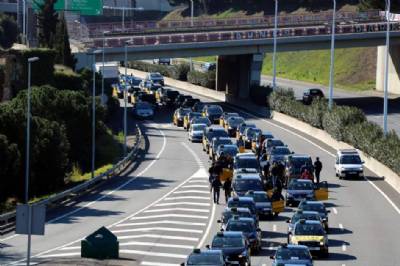
Photograph: A taxi-driver protest in Barcelona earlier this year
HIGH-SPEED rail services between Spain's largest two cities and France have been snapped up by half a million passengers in less than nine months, reveals the transport board.
LOW-COST self-service petrol station chain Ballenoil plans to open a further 110 premises in Spain this year on top of the 233 it already operates nationally.
LEARNING to drive may sound as thrilling as it is daunting, but can be one of the most frustrating times in a young adult's life – and one of the most expensive, too.
EVERY now and again, Spain's traffic authority launches a campaign to remind drivers of what they should and should not be doing, or to answer common questions – such as, can drivers be fined if passengers do not...